
Blog
Free Property Management Software: What You Actually Get in 2026
Free property management software is real, but every free plan pays for itself somehow. Here's how the free models work, what they typically leave out, and how to choose without regrets.
Written by
Published on
Read time
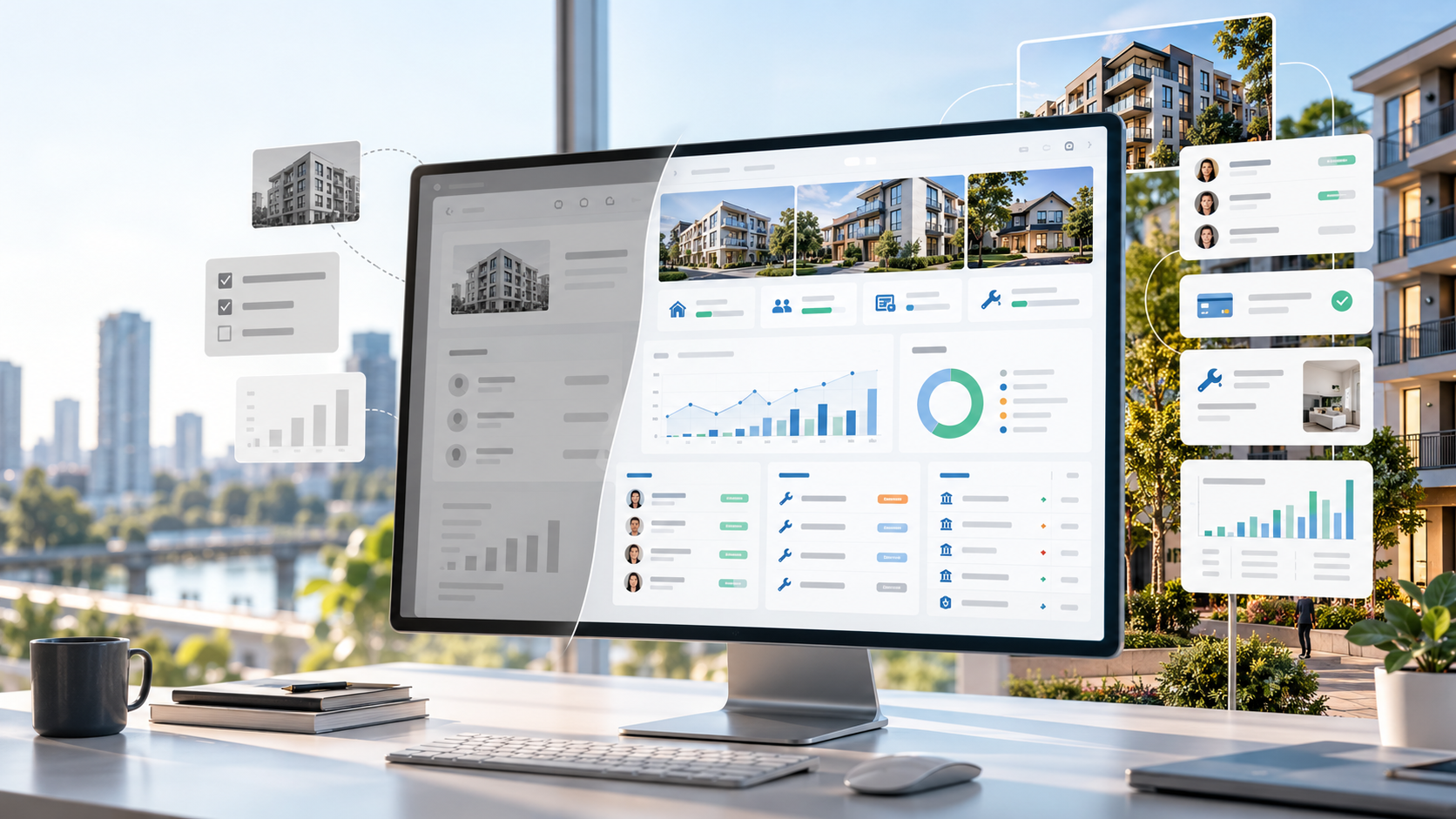
Quick answer: Yes, genuinely free property management software exists, and for a landlord with a few units it can work well. But "free" always has a business model behind it — tenant-paid fees, upsells, lead generation, or a trial that converts to paid. The features most often missing from free plans are the ones that matter most at tax time: real double-entry accounting, bank reconciliation, and QuickBooks sync. The smart move is understanding how each free option gets paid, then deciding whether that model aligns with your needs — or whether a long free trial of a full platform (RentAxis gives you 180 days) tells you more than a permanently limited free tier.
Search "free property management software" and you'll find two kinds of content: vendor pages insisting their free plan is complete, and listicles that haven't been updated since the pricing changed. Neither answers the question you're actually asking, which is: can I run my rentals properly without paying for software, and what's the catch?
We run a paid platform, so you know where we stand, but we also started exactly where you are, managing a handful of Boston-area units with spreadsheets and good intentions. So here's the answer with the incentives laid on the table.
Nothing is free: the four business models behind $0
Software costs money to build and run. When you don't pay, someone does. Every free property management tool runs on one of these engines, and knowing which one tells you what the product will and won't do well:
1. Tenant-funded. The landlord pays nothing; tenants pay convenience fees on payments, application fees, or optional services (renter's insurance, credit reporting). This model can be perfectly fair — but notice the incentive: the product optimizes for transaction volume and tenant-side monetization. Rent collection will be polished. Deep landlord accounting usually won't be, because it doesn't generate fees.
2. Freemium ladder. The free tier is real but capped — by units, by features, or both — and exists to convert you to a paid plan as you grow. Nothing sinister here; it's how most software works. The thing to check is where the ladder's rungs are. If the features behind the paywall are the ones you'll need at exactly the moment you're busiest (accounting, maintenance workflows, team access), you're not choosing free software, you're choosing a delayed purchase — so evaluate the paid tier now.
3. Lead generation and placements. Free tools attached to listing sites, insurance marketplaces, or mortgage lead pipelines. The software is the top of someone else's funnel. Often fine for basic use; just understand you and your tenants are the product, and expect steady cross-selling.
4. Genuinely free trials of paid products. Not a permanent free tier, but full access for a defined period. The honest question here is whether the trial is long enough to matter. Fourteen days can't evaluate rent software — you need complete rent cycles. This is why we made RentAxis free for 180 days with real limits high enough for a serious portfolio (100 properties, 150 units): six months of actual operations is enough to know, with certainty, whether software earns its keep.
None of these models is wrong. But "which free option is best?" is really the question "which business model's tradeoffs match my situation?"
What free plans almost always do well
Credit where due — the free tier of the market has genuinely solved some problems:
Online rent collection. ACH payments, basic autopay, payment tracking. Because payments monetize (models 1 and 3), this is where free products invest.
Listings and applications. Posting a vacancy, collecting applications, running tenant-paid screening. Again — monetized, therefore good.
Basic record-keeping. A place to store leases and see who's paid. A meaningful upgrade over a shoebox.
If your entire need is "two units, collect rent online, keep the lease PDF somewhere," a free tool may honestly be all you need for now. We'd rather tell you that than pretend otherwise.
What free plans almost always leave out — and why it bites in April
Here's the pattern across the free landscape, and it isn't accidental: the gaps cluster around accounting, because real bookkeeping is expensive to build and generates no transaction fees.
Double-entry accounting. Free tools track payments; they rarely maintain balanced books. The difference sounds academic until your CPA asks for a balance sheet, or a lender asks for a P&L per property, or a partner asks why the numbers don't reconcile. A payment list can't answer; books can.
Bank reconciliation. Importing bank transactions and matching them against your records monthly is how errors get caught while they're small. Without it, discrepancies compound silently for a year and surface during tax prep — as billable CPA hours.
Security deposit handling. Deposits are liabilities — someone else's money you're holding, often with state rules about it. Free tools routinely lump deposits into income or ignore them structurally, which is both wrong and, in some states, legally exposed.
QuickBooks sync. If your accountant works in QBO (most do), you'll be re-typing or CSV-wrangling everything. The double data entry you were avoiding comes back, monthly, forever.
Maintenance workflows. A request inbox at best. Work orders, contractor access, photo documentation, cost tracking per unit — usually paid-tier.
Housing program support. If you take Section 8 vouchers, free tools are essentially a non-starter — split PHA/tenant rent and lump HAP payment reconciliation don't exist in that world.
Audit trails and team roles. Fine when it's just you. The moment a spouse, bookkeeper, or helper touches the system, "who changed this?" becomes a question you want answerable.
Run the math honestly: if missing accounting costs you five extra CPA hours a year, that's frequently more than a full platform's annual subscription — before counting a single lapsed late fee or missed renewal.
A decision framework that respects your budget
Rather than "free vs. paid," ask these four questions:
1. Is my portfolio a hobby or a meaningful asset? One inherited condo you'll sell eventually: free is fine. A portfolio that represents a serious slice of your net worth and retirement plan deserves books-quality records — the same way you wouldn't run a $500K business on a notes app.
2. Where will I be in three years? Migration is the hidden cost of free. Switching platforms mid-growth — re-importing data, re-onboarding tenants, reconstructing history — is painful enough that most people delay it past the point of pain. If you're acquiring, start on something that scales.
3. Who does my taxes, and what do they need? Ask your CPA one question: "what would make your job easier?" If the answer mentions QuickBooks, clean categorization, or per-property statements, your software choice just made itself.
4. What does my time cost? Free tools shift work to you — manual reconciliation, spreadsheet supplements, workaround maintenance. At even a modest value on your hours, "free" software that costs you three extra hours a month is the most expensive option on the list.
The middle path: a free trial long enough to be honest
There's a reason we keep returning to trial length. The dirty secret of software evaluation is that you can't know whether a platform fits from a demo, a features page, or two weeks of poking around. You know after you've:
Run at least one full rent cycle — invoices out, payments in, a reminder fired, a late fee applied
Handled one real maintenance request end to end
Closed one month's books and reconciled the bank
Pulled the income statement and shown it to whoever does your taxes
That takes 60–90 days minimum to do once, and doing it two or three times is what builds actual confidence. It's why the RentAxis free period is 180 days with working limits of 100 properties and 150 units — not a teaser, but six real months of operations. If at the end of it the platform hasn't obviously paid for itself in time and caught leaks, you'll know, and you'll have clean exportable records either way. That's a better deal than a permanently crippled free tier that quietly costs you every April.
Frequently asked questions
Is there any completely free property management software with no catch? There are tools with no landlord-paid subscription, yes. There is none with no business model. Tenant fees, upsells, lead-gen, or conversion to paid — one of them is always present. The "catch" isn't hidden malice; it's that the product invests where it earns, and that's rarely your accounting.
What's the best free option for a landlord with 1–3 units? The one whose monetization you're comfortable with and whose gaps you've consciously accepted. For most very small landlords, that means: free tool for rent collection and listings, plus a deliberate plan for the books (even if that plan is "a clean spreadsheet my CPA approved"). Going in eyes-open beats any specific brand recommendation, because free tiers change constantly.
Can I start free and upgrade later? Yes, and it's a legitimate strategy — if you're staying within one platform's ladder. Upgrading a tier is a settings change; migrating between platforms is a project. Choose the ladder, not just the rung.
Is free software safe for storing tenant data? Hold free tools to the same standard as paid: encryption in transit and at rest, credible backup practices, and a straight answer about how tenant data is used commercially. In lead-gen models especially, read the privacy policy — your tenants' data may be part of the revenue.
Why does accounting matter if I only have a few units? Because the events that punish weak records — a tax audit, a deposit dispute, a refinance application, a partnership disagreement, a sale — don't scale down for small portfolios. One unit's deposit dispute in housing court needs the same documentation quality as fifty.
RentAxis isn't free forever — but it's free for 180 days with limits big enough to run a real portfolio: rent collection, full double-entry accounting, two-way QuickBooks sync, maintenance with contractor portals, and Section 8 rent splitting. Six months of real operations, then decide. Start for free →
More posts
Explore more articles
Managing Section 8 Rentals Without the Paperwork Headache: A Software Guide for Landlords
Section 8 rentals mean split payments, HAP reconciliation, and PHA paperwork most software can't handle. Here's how to manage voucher tenants without drowning in admin.

Property Management Accounting: Why Plain QuickBooks Eventually Breaks (And What to Do About It)
QuickBooks wasn't built for rentals. Here's where it breaks for landlords — unit-level tracking, rent invoicing, security deposits — and how to fix your books without abandoning QBO.

How to Choose Property Management Software in 2026 (A Landlord's Honest Guide)
Choosing property management software in 2026? Here's what actually matters: rent collection, accounting, portals, maintenance, communication, and integrations.